
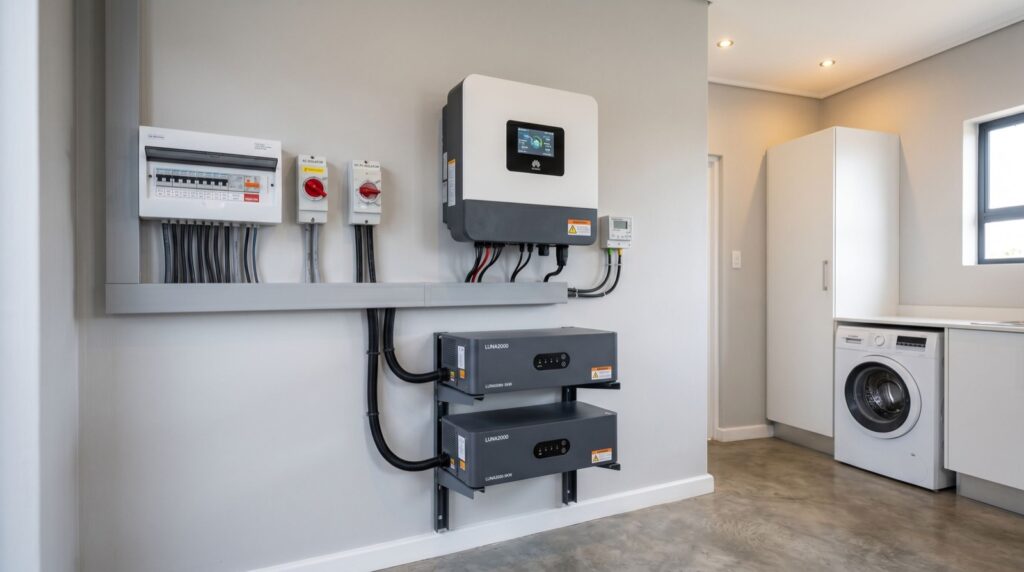
Panels get all the glamour, but the inverter quietly decides whether your solar system feels like an upgrade or an expensive lesson. It is the component that converts DC from the roof into usable AC power, manages batteries if you have them, and determines what happens in your house the moment the grid disappears — which, for most Pakistani households, is not a hypothetical scenario.
Yet many buyers walk into a shop having researched panel brands for weeks and pick the inverter in five minutes because “the dealer recommended it.” Let’s fix that. There are three fundamental architectures on the market, and choosing between them has less to do with catalogues and more to do with your street.
Start With Your Grid Situation, Not the Brochure
On-grid (grid-tied) inverters
These are the cheapest per kilowatt and the simplest machines of the three. They synchronise with WAPDA supply, feed surplus into the grid under net metering, and involve no batteries at all. The catch is anti-islanding: the second the grid drops, an on-grid inverter must shut down for safety. If your feeder sees six hours of load shedding daily, a pure on-grid setup leaves you sitting in the dark beneath a roof full of generating panels.
Hybrid inverters
The hybrid has become the default choice for urban Pakistan, and for good reason. It can run loads from solar, charge and discharge batteries, pull from the grid, and export surplus — juggling all four sources according to priorities you set. Even buyers who skip batteries initially often choose a hybrid so they can add storage later without replacing the brain of the system.
Off-grid inverters
Built for locations where WAPDA either does not reach or barely functions: tube wells, farmhouses, remote KPK villages, cabins. They demand a properly sized battery bank because there is no grid to lean on. Buying off-grid hardware for a city home is usually a mistake; buying grid-dependent hardware for a village with four hours of daily supply is a bigger one.
The Five-Question Decision Test
Answer these honestly and the right architecture almost picks itself:
- How many hours of load shedding does your feeder actually experience in June — not on average, but at worst?
- Is net metering realistically available to you, and have neighbours on your transformer successfully obtained it?
- During an outage, what must keep running — fans and Wi-Fi, or a refrigerator plus an inverter AC?
- Can the budget absorb batteries today, or is battery-readiness for next year enough?
- How much DC capacity will sit on the roof? Most quality inverters happily accept 1.2–1.3 times their AC rating in panels, which changes your sizing math.
Two “grid is unreliable” answers generally point at a hybrid. All five leaning toward stability and export make on-grid the financially sharper play.
Match the Machine to Your Heaviest Appliance
Architecture settles the type; your appliances settle the size. List the loads you expect to run simultaneously on a summer evening and pay special attention to anything with a motor. A 1.5-ton inverter AC may cruise at around a kilowatt yet demand considerably more at compressor start, and a water pump behaves the same way. Continuous ratings on a spec sheet mean little if the surge rating cannot absorb these spikes without tripping.
Households on three-phase connections face an extra fork in the road: a single large three-phase inverter, or separate single-phase units per phase. The three-phase route is cleaner for net metering and balancing, while the modular route offers redundancy — one failed unit no longer darkens the whole house. Neither answer is universally right, but discovering the question after purchase is universally expensive.
What You Should Expect to Pay
Checking the going solar inverter price in Pakistan before visiting any showroom gives you an anchor that dealers cannot drift far from. As of mid-2026, a 6 kW on-grid unit from a recognised Chinese brand typically lands somewhere in the low two-hundred-thousands of rupees, while 6 kW hybrids span a wider band — roughly two hundred fifty thousand to four hundred fifty thousand — depending on whether they support high-voltage lithium batteries, parallel stacking, and dual MPPT trackers with generous input current for modern 580 W+ panels.
Treat suspiciously cheap quotes as a compatibility question, not a bargain. An inverter whose MPPT current limit chokes your bifacial strings will cost you output every day for a decade, quietly outspending whatever it saved you upfront.
Brand Tiers and the Fine Print Nobody Reads
The Pakistani market has sorted itself into rough bands: premium imports with strong local service networks, mid-market Chinese brands with growing spare-parts availability, and budget or locally assembled units where after-sales support can be a WhatsApp number that stops replying. Rather than memorising brand names, interrogate three things: whether an authorised service centre exists in your province, whether replacement boards are stocked locally or ordered from abroad, and how long the standard warranty runs — five years is the baseline, with paid extensions to ten increasingly common.
Also check the ingress protection rating against your mounting plan. An IP65 unit tolerates a shaded external wall; anything less belongs indoors, ventilated, and away from kitchen humidity.
A Word for Buyers in KPK
Khyber Pakhtunkhwa adds its own variables to the equation. Rural feeders around Kohat, Hangu and Karak often swing between 170 and 250 volts, so an inverter with a wide grid-input voltage window survives conditions that trip narrower machines into constant fault cycles. Summer rooftop temperatures also argue for units with sealed, fanless cooling or easily cleanable intakes, because dust-choked fans are the leading cause of premature derating in the region.
This is where sitting across the table from an established solar company in Kohat beats ordering blind from a national marketplace: a local firm knows which machines have already survived three summers on the very feeders you live on, and which models fill their repair bench. Vetting them follows the same logic you would use to shortlist trusted professionals for any consequential household decision — verifiable track record first, promises second.
The Bottom Line
Buy the inverter for the grid you actually have, not the grid you wish you had. Stable supply and approved net metering reward the lean economics of on-grid hardware. Load shedding, voltage swings, or any ambition of adding batteries point firmly toward a hybrid. And wherever you land, the brand’s service bench matters more than its brochure — because ten years is a long time, and the roof is the easy part.