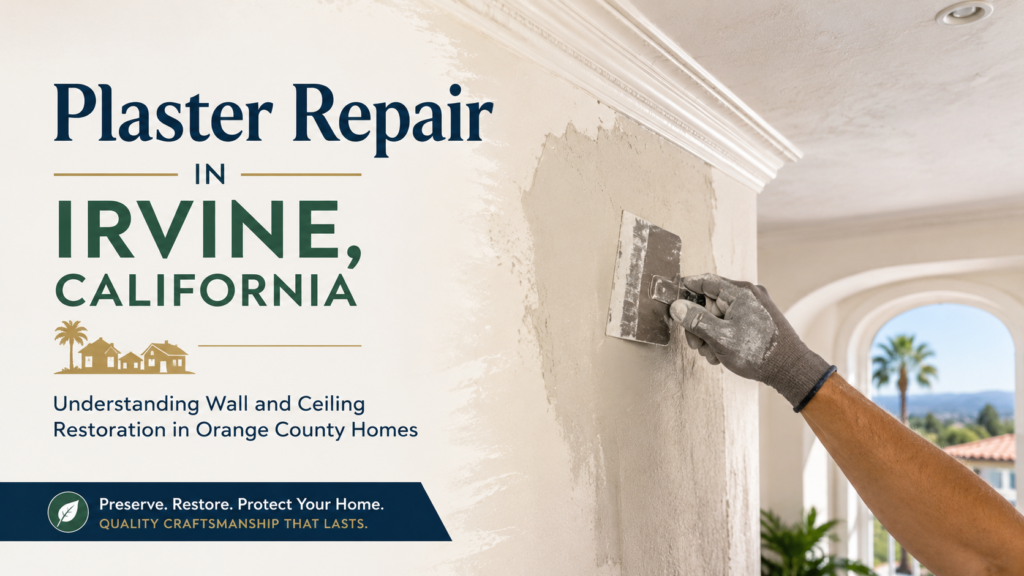
Irvine, California is a city that blends eras of construction from mid-century ranch homes in established neighborhoods to the planned communities that have expanded the city since its incorporation in 1971. Across this building stock, plaster walls and ceilings remain a feature of many older homes, and even newer construction occasionally incorporates plaster finishes for their distinctive texture, acoustic qualities, and visual character. When plaster surfaces develop cracks, holes, water damage, or structural delamination, understanding what Plaster Repair Irvine involves and what distinguishes quality repair from cosmetic patching is essential for Irvine homeowners who want results that last.
Understanding Plaster vs. Drywall
Before addressing plaster repair, it’s worth understanding what distinguishes plaster from the drywall that is standard in most post-1960s construction. Traditional plaster walls are built from multiple layers a base of wood lath strips (or, in mid-century construction, metal lath or gypsum board lath), over which successive coats of plaster are applied, each allowed to cure before the next is added. The result is a surface that is harder, denser, and more durable than drywall, with a depth and texture quality that drywall cannot replicate.
Modern plaster applications Venetian plaster, smooth skim coat plaster, and various textured finishes are applied over drywall or other substrates as single or multi-coat systems. These finishes are common in higher-end Irvine homes and commercial interiors seeking distinctive wall character. Repairing these modern plaster finishes requires matching both the material composition and the application technique of the original work.
Common Types of Plaster Damage in Irvine Homes
Irvine’s climate warm, dry summers and mild winters with occasional rain events creates specific patterns of plaster damage:
- Hairline cracking: Fine surface cracks that follow the plaster coat’s surface. In Southern California, hairline cracking is frequently associated with seasonal moisture cycling and the thermal expansion and contraction of the building structure. Minor hairline cracks are primarily cosmetic but should be addressed before repainting to prevent them from showing through the paint film.
- Structural cracks: Wider cracks, particularly those that change width over time or are accompanied by visible displacement, may indicate underlying structural movement. These cracks require investigation of their cause before repair filling a crack caused by ongoing movement will produce a recurring crack.
- Water damage: California’s occasional intense rain events can cause roof or plumbing leaks that saturate plaster, causing it to bubble, stain, crack, and ultimately lose adhesion to its substrate. Water-damaged plaster repairs must address the moisture source before the plaster is repaired, or the same damage will recur.
- Key failure (delamination): Traditional lath-and-plaster walls depend on the plaster’s mechanical bond to the lath through the gaps between strips. When the plaster keys (the portions that grip the lath) break loose typically from age, moisture, or impact the plaster face begins to separate from the lath and eventually sags or falls. This is the most serious form of plaster failure and often requires section replacement rather than surface repair.
- Impact damage: Holes and dents from door handles, furniture, and accidental impacts are common in residential plaster surfaces.
The Plaster Repair Process
Quality plaster repair in Irvine follows a sequence appropriate to the type and extent of damage:
- Damage assessment: Before any repair material is applied, the damaged area is assessed to understand the extent of damage, the condition of the substrate and lath (for traditional plaster), the source of any moisture, and the type of plaster being repaired.
- Substrate stabilization: Loose or delaminated plaster is either secured (using plaster washers and screws to pull sagging sections back against the lath) or removed. Attempting to plaster over sections that are actively separating produces repairs that fail quickly.
- Moisture source elimination: If the damage is water-related, the source roof leak, plumbing failure, condensation must be identified and corrected before repair begins.
- Area preparation: Damaged plaster is removed to solid edges, loose material is cleaned out, and the repair boundaries are defined. For traditional plaster, the lath is inspected and repaired or supplemented as needed.
- Bonding agent application: A bonding agent applied to the repair area promotes adhesion between the existing plaster and the repair material, which is essential because new plaster applied directly to old surfaces may not bond adequately without this preparation.
- Patching in layers: Traditional plaster repairs are applied in multiple coats a scratch coat, brown coat, and finish coat following the same layered approach as the original installation. Rushing through to a single-coat application produces repairs that are more likely to crack or show inconsistent texture.
- Texture matching: For textured plaster surfaces, matching the original texture is the most technically demanding aspect of the repair. Experienced plasterers develop an extensive repertoire of techniques skip trowel, orange peel, smooth hard finish, hand-applied textures to match existing surfaces. Color painting over a mismatched texture produces a visible repair.
- Priming and painting: Repaired plaster requires appropriate priming before painting. New plaster is highly alkaline and must be fully cured before painting; skipping the primer or painting too soon produces peeling and adhesion failures.
Plaster Repair vs. Drywall Replacement
In Irvine and across Orange County, a common decision point in plaster repair is whether to repair the original plaster or replace the damaged section with drywall. For historically or architecturally significant plaster work, repair preserves the original character. For large sections of failed traditional plaster in utility areas, drywall replacement may be more practical. When replacing traditional plaster sections with drywall, careful attention to thickness is required traditional three-coat plaster is typically 5/8 to 7/8 inch thick, and a drywall replacement section must be built out to the correct thickness to be flush with the surrounding surface.
Conclusion
Plaster repair in Irvine requires an understanding of what plaster is, why it fails, and what proper repair technique involves at each stage of the process. From identifying the damage type and addressing any underlying moisture or structural cause, through multi-coat patching and expert texture matching, quality plaster repair is a skilled trade that produces results indistinguishable from the original surface. Irvine homeowners who understand this process can better evaluate contractor proposals and recognize the difference between a quick cosmetic patch and a repair that will genuinely last.